Wednesday, May 20, 2015

Jaime Casap Explains Why Global Competence Matters: It's Not Really a Small World

This contribution was originally posted in Education Week on May 18, 2015. It is part of a weekly group blog curated by Heather Singmaster (Asia Society) in which education leaders discuss global competence based on best practices from around the world.  Follow Asia Society on Twitter.

Jaime Casap, Chief Education Evangelist at Google, Inc. shares why global competence is critical for students. Join him this Thursday, May 21st at 8pm ET/5pm PT for a special #globaledchat on Twitter. (Just search for #globaledchat to join the conversation).
By guest blogger Jaime Casap
With all due respect to the dancing dolls in Anaheim, it really isn't a small world.  It is a complex, multifaceted, diverse, and complicated world. Most of us hardly understand it yet the growing availability of the Internet and low-cost devices to connect to all the world's information brings the complexity of this world to your fingertips.  In 1995, just 1% of the world was online. Today, more than 40% of the world is. It took just 20 years to get three billion people online. This global achievement calls for all of us to understand what is happening around the world, why it is happening, and how it impacts us more than ever.
Local Companies, Global Competition From a commerce perspective, gone are most organizations that do not compete on a global scale. In fact, there is a good chance our students will work for a global organization at some point in their careers. Even Paul Bond Boots, a small rural cowboy boot store in Nogales, Arizona, has a global customer base! With companies like Google, Facebook, Netflix, and others, most companies who are U.S.-based operate 24 hours a day on a global scale. In education, we often talk about how it's critical it is to teach our students the "Four C's": communication, collaboration, critical thinking, and creativity. While I agree these are critical competencies our students should master, what we miss in this discussion is an emphasis on another very important C, global competency.
Even if a graduate never works abroad or in a global organization, we still need to make sure our students are exposed to learning global competency skills. Since its inception, the United States has been comprised of people from all over the world. Whether you just arrived in the U.S. or are fifteenth generation, all of us have one common characteristic: we all have a First Generation story. And it doesn't look like this trend is slowing. The U.S. continues to become more linguistically and culturally diverse. For example, in the next few years, one in four students in our public school system will be Latino. By the year 2045, the U.S. will be a "minority majority" country, meaning there will be more Americans who identify as minorities as a group than whites.
Organizations who will thrive in this global, diverse economy will understand how not only having a diverse workforce will be a competitive advantage, but having a workforce that understands and appreciates people from other cultures and one that can identify and acknowledge different points of view will stay relevant. Companies who focus on awareness and understanding of cultural issues at home and around the world will continue to expand and remain competitive. Having this awareness and understanding will help organizations to design products and services that appeal to a culturally diverse, global audience. 
The Imperative of Global Competency So what does a globally competent student look like? Globally competent students can see and understand the interconnectivity and interdependence between what we do here in the United States and the rest of the world.  This means they will understand how problems facing the rest of the world impact us here at home and vice versa. Students who are globally competent have in-depth knowledge and understanding of international issues, an appreciation of people from culturally diverse backgrounds, and the knowledge, skills, and experiences to call themselves global citizens. Most American students, and especially low-income minority students, are behind their peers in other countries in their knowledge and understanding of world issues, world geography, and cultural understanding and experiences. 
We often ask our students, "What do you want to be when you grow up?" I do not believe that is the right question. First, all the labor forecasts predict that most jobs of the future haven't been defined yet. Second, we already have jobs most students wouldn't recognize, like "Bio-Medical Engineer" or "Sustainable Materials Architect." Instead of asking our students what they want to be when they grow up, we should ask them what problem they want to solve. We should ask them to think about what knowledge, skills, and abilities they need to solve that problem. We should ask them to think about where they can get the knowledge, skills, and abilities they will need. We should ask them to think about how the problem they want to solve fits into the context of the world.
We need to create a generation of critically-thinking, collaborative problem solvers. Students who know and understand world issues. Students who understand political and socioeconomic systems on a global scale. Students who recognize and appreciate cultural diversity. If we really want to face and solve the problems of this complex, multifaceted, diverse, and complicated world, we need a generation of students who are strong in all the C's: communication, collaboration, critical thinking, creativity, and global competency.
"There is just one moon and one golden sun,And a smile means friendship to everyone,Though the mountains divide,And the oceans are wide,It's a small world after all..."- Walt Disney

In addition to his role at Google, Jaime serves on the Board of Directors of New Global Citizens, a global competency non-profit helping teachers integrate global education into the classroom. Jaime is also an adjunct professor at Arizona State University.
You can reach and follow Jaime on Google+ and Twitter. Follow Heather on Twitter.

Friday, March 20, 2015

Global Enthusiasm Revealed at Summit

By Benson Gardner, Wisconsin Department of Public Instruction
Original post at DPI-ConnectEd on March 19, 2015
So engaging are international topics — for a significant population of Wisconsin students — many had to be turned away from the third annual Wisconsin Global Youth Summit in Madison last month.

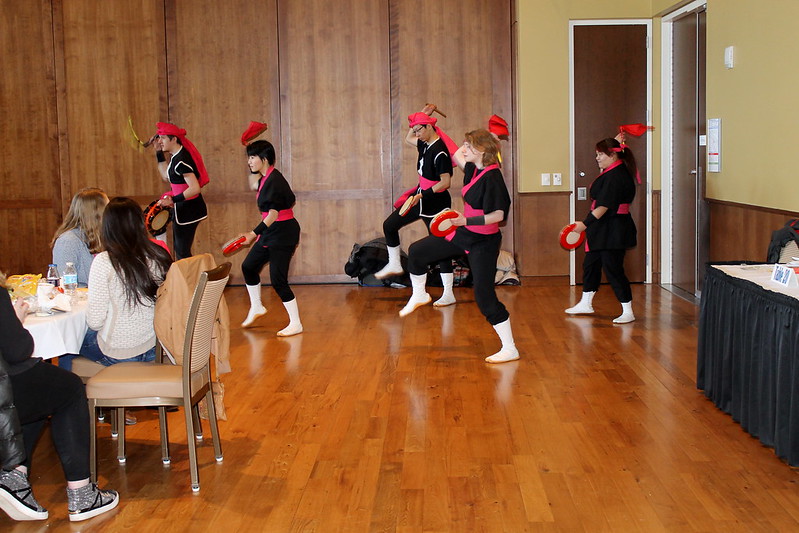
traditional dance
Students at this year’s event saw performances of Eisa -- a folk dance from Ryukyu (Okinawa), Japan, which incorporates taiko drumming and martial arts -- as well as South African gumboot dance, learning about cultural connections. They also met international university students and discussed global citizenship. Pictured is Anaguma Eisa, UW-Madison's Okinawan Taiko Club. Photo: Angela Bublitz, for the UW-Madison Division of International Studies

Gerhard Fischer, DPI international education consultant, feels the growing popularity of this event confirms that there is “enthusiasm for global learning” among Wisconsin students.
“I mean, 170 kids on a Saturday, for a full day? They don’t do that unless something interests them.”
And some students “may not even know yet that they’re interested” in international education if they haven’t experienced it very often, Fischer says.
Fischer says the Department of Public Instruction and the University of Wisconsin-Madison, which jointly organize the summit, had to cap attendance because of limitations on the time of volunteers needed to make the event run.

Teachers working at a table with a newsprint sheet on which is handwritten the title, 'What Comptencies shoudl students demonstrate through Cultural Literacy'. Below are various sticky notes in a variety of colors.
Approximately 65 Wisconsin teachers -- who brought the students -- met separately to talk about ways they could implement programming in their schools and classrooms that helps students achieve the Wisconsin Global Education Achievement CertificatePhoto: Angela Bublitz, for the UW-Madison Division of International Studies.

Students also met in small groups to talk about how to increase global awareness in their own communities. Kerry G. Hill of the UW-Madison Division for International Studies reports these “key themes emerged”:
  • More academic opportunities to learn international languages, arts, culture, and sports, as well as non-American viewpoints in history and global issues.
  • Boost global appreciation through new and existing organizations and events. Learn through cultural food events.
  • Connect more through exchanges, pen pals, Skype, sister city partnerships, guest speakers, and collaborations with other students.
  • Service projects, such as to teach languages to younger students, or to assist international populations, locally or worldwide.
  • Visiting culturally diverse places, whether nearby -- like mosques, synagogues, museums, and ethnic restaurants – or abroad through service projects.
  • More statewide conferences, like the Global Youth Summit, to help more students connect with like-minded peers, and perhaps take on collaborative projects.
Global competency, Fischer says, is “all about understanding different perspectives and where different people are coming from. Different folks in different parts of the world approach ... problems differently.”
He emphasizes that global learning is a method of student engagement that should be woven into other subject areas.
“It’s not an add-on, it is an approach to learning that should be natural. So as a science teacher if I don’t occasionally reference the real natural world beyond Lake Superior maybe I’m not doing it right. If as an economics teacher I’m not talking about the global economy, maybe I’m not doing my job. So, not, ‘Create a new course,’ just, ‘Work it in to what you’re doing.’ Teachers and students should routinely consider the global scope of various concepts, whenever it's relevant."

Yellow notepaper folded by a participant into an origami crane
Photo: Angela Bublitz, for the UW-Madison Division of International Studies

Friday, March 13, 2015

Wisconsin Global Youth Summit generates ideas for raising global awareness

Incorporating international news reports into school-wide announcements, having high school students give language lessons to elementary students, and hosting international dinners for the community are among the ideas for increasing global awareness offered by high school students at the 2015 Wisconsin Global Youth Summit.
The Wisconsin Global Youth Summit brought approximately 170 students from more than 35 high schools across Wisconsin, accompanied by more than 60 teachers, to the University of Wisconsin-Madison campus on Saturday, February 28, for a day of sessions aimed at promoting their growth as global citizens.
The summit was co-sponsored by the UW–Madison Division of International Studies and the Wisconsin Department of Public Instruction. Participating UW–Madison units include the Wisconsin International Scholars (WISc) Program, International Reach (International Student Services), Language Institute, and the Wisconsin International Outreach Consortium (WIOC).
These sessions were designed:
  • To encourage students to think about themselves and the world around them.
  • To broaden their perspectives through contacts with people from diverse backgrounds.
  • To have them recognize that being internationally engaged can be fun and exciting.
Students at the summit are introduced to a variety of languages.
Students at the summit are introduced to a variety of languages. (Photo: Angela Bublitz)
Over the course of the day, the students interacted with members of the UW-Madison community –domestic and international students and staff, who all share strong interests in increasing cross-cultural awareness and engagement.
The high school students learned about South African gumboot dancing, discussed global citizenship, and interacted with individuals from the university’s international community.
Most of the participating students made it clear that they already were well on their way to becoming global citizens. Based on a show of hands, most are studying other languages, know individuals from other countries, possess passports and have traveled outside of the United States.
In addition to providing encouragement and inspiration, the summit also enabled students to speak with a collective voice. While their teachers discussed ways to enhance international education in a separate session next door, the students met in small groups to generate their own ideas for increasing global awareness in their schools and communities.
And they had plenty to say. Some key themes emerged:
Strengthen academics: They called for more opportunities to learn languages – including self-study of languages not offered by their schools – and to study other culturally focused subjects, such as sociology, anthropology, global issues, arts and literature from other cultures, history from a non-American viewpoint, and physical education with more internationally popular sports.
Boost global appreciation through organizations and events: They see new and existing school clubs as another means to promote global awareness, such as Model UN, international/global connections, world events, culture, and languages. Such organizations could host school-sponsored events such as cultural fairs, international days, and foreign films showings, open to the community. Creating an honor society for global awareness could provide recognition students who excel in their pursuit of international interests.
Eat and learn: Cultural cuisine could be featured through picnics and potlucks, meals served at school, and items sold for fund-raising. This could even be extended into the community, such as hosting an “international dinner” or delivering special meals to people in need.
Connect more, locally and globally: Students – individually or through organizations or classes – can become more globally aware by interacting more with exchange students, connecting with pen pals, Skyping with peers in other countries, bringing speakers on international topics into schools, getting involved with sister cities and other partnerships, and developing collaborative teams and projects with their peers in other school districts.
Use service projects as a vehicle: They suggested organizing “language days,” in which high school students, for academic or volunteer credit, teach languages lessons to younger students. Other approaches to service include engaging in projects that benefit local ethnic/immigrant residents, and raising funds to support international causes.
Go places, near and far: They suggested taking school trips to culturally diverse places nearby, such as mosques, synagogues, museums, and ethnic restaurants; going abroad on service projects that would require language immersion, such as students in Spanish doing volunteer work in Guatemalan orphanages; and advertising opportunities and raising funds for study abroad.
Bring more like-minded students together: They called for more statewide conferences, like the Global Youth Summit, so that more students can connect with like-minded peers around the state, and perhaps take on collaborative projects.
– by Kerry G. Hill
Students at the summit interact with members of UW-Madison's international community. (Photo: Angela Bublitz)
Students at the summit interact with members of UW-Madison’s international community. (Photo: Angela Bublitz)

More from the 2015 Wisconsin Global Youth Summit:

Tuesday, March 3, 2015

Yes, We Can Educate Globally Competent Students.

Fiscal realities in our schools make it difficult to add important elements in the curriculum. It is increasingly hard for small districts to hire world language teachers and extend the sequence of language learning for students. There is no way Wisconsin students can compete with peers from most advanced countries who begin their third world language in ninth grade.

Yet, students and teachers in our schools actively ask for the exciting opportunity to learn more about the world. They are hungry for those learning experiences, and they engage whenever they can. Imagine 170 students attending the 2015 Wisconsin Global Youth Summit on a cold Saturday in February. Imagine 65 of their teachers joining a full-day workshop while their students participated in exciting global learning opportunities. All of them gave up a free Saturday; all of them were engaged all day long. The teachers did not get extra pay or compensation for their time. This is the power of engaging students and teachers in global learning activities and in an exciting day of events. And this is what makes me feel a slight sense of optimism in an otherwise very challenging educational environment. This is also evidence of many teachers doing more with less.

Teaching students essential literacy and mathematical skills is absolutely necessary, and it is a bottom line requirement. That does not mean that we cannot reach higher and engage students in learning about the real world in which they live. They need authentic learning experiences, they need to understand what they are studying for. They need to understand that inquiry, curiosity and learning knows no boundaries. They need to know that solutions to problems and ways to improve living conditions are global issues. If our students do not learn about other points of view, they are not given an opportunity to think critically.

The 2015 Wisconsin Global Youth Summit was every bit as inspiring and uplifting as previous summits. The number of interested students, teachers and schools is growing rapidly.
Take a look at the schedule of events at www.globalwisconsin.org.

Yes, we can educate globally competent students who will engage in interesting careers and the construction of civil societies in the very near future. This is an exciting prospect for Wisconsin.

Tuesday, December 30, 2014

A Unified Plan of Action for 2015

By Gerhard Fischer, DPI Consultant for World Languages and Global Education

I am writing these lines on the last working day of the year 2014. You can look back on many highlights that include daily triumphs of engaging students in learning another language and trying to make sense of a world that is so much bigger than their immediate environment. Even though this may not be apparent every day, teachers are changing lives, inspire young people and encourage them to become the best they can be. All educators try to do that, but the enthusiasm among world language teachers is unparalleled. I can see that every year at the WAFLT Convention in Appleton but also during the WAFLT Summer Institutes and other meetings dedicated to improving professional practice.

We can probably agree that one of the most important contributions of our professional association, WAFLT, to teacher success in the classrooms is the establishment of a sense of community and collegiality. World language teachers, even though they might feel isolated in their schools without colleagues in the same content area, understand that professional growth occurs best by working with colleagues and friends.  And that is undoubtedly a good reason for strong registration numbers at all WAFLT events.

I just came across an older (2013) article in the Washington Post, entitled “What if Finland’s great teachers taught in U.S. schools?” Pasi Sahlberg, author of “Finnish Lesson,” discusses U.S. education reform movements that more recently have focused on teacher effectiveness. In Finnland, he argues, they don’t pay much attention to student outcomes based on standardized testing. Nor do they try to establish a direct link between student performance on such tests and teacher effectiveness. Instead, Finland standardizes teacher education programs and requires a master’s level of education in the content area before candidates can begin teaching. Most importantly, though, teachers in Finland are required to work together, to critique and help each other. In other words, a school and teacher community is designed to help everyone succeed. International tests show that this approach is highly successful. By contrast, reform movements in the U.S. appear to focus on individual teachers by trying to assess their individual efficiency. What would happen, the article asks, if those highly successful Finnish teachers were to teach in U.S. schools? Would they be highly effective by U.S. standards? Sahlberg argues that they would most likely fail and drop out of teaching within a few years. Why? Because the education system is designed differently and because individual teachers cannot dramatically change student learning outcomes unless the entire system supports what they are trying to do. Sahlberg gives an example from team sports and remembers the U.S. hockey team that surprisingly won the gold medal in the 1980 Olympic Games. The quality of the individual players was not even close to the best teams in the world, such as the Soviet Union. But the U.S. team spirit forged something that was far bigger than those individual qualities: As a team, they transcended individualism.

This analogy makes perfect sense for world language teaching (and for all teaching and learning). As world language teachers, we thrive best in a community that supports our overall goals. Does your school fully embrace the need for more world language instruction? Does your school or school district increase opportunities for all students to learn more about the world? Or, conversely, are you isolated in a classroom with no real professional connections with teachers in other content areas?  Do others reach out to you, and do you reach out to others?

The year 2014 marks the first year of Wisconsin’s educator effectiveness initiative. The Wisconsin Association for Language Teachers (WAFLT) offered a full-day pre-conference workshop on writing SLOs for world language teachers. The summer institute also devoted significant time to this topic. The effectiveness of a teacher will be captured by measures defined by the individual teacher and the school community. This is a perfect opportunity to initiate or continue a strong conversation about the goals of world language programs: What can all of us do to increase the proficiency levels of our graduating students? What can we all do to involve the entire school community in conversations about the need for more global and world language education? What can we all do to demonstrate our contribution to high literacy levels?

We are in the process of creating an entirely new community that includes world language educators. Wisconsin’s new Global Schools Network is a network of schools that have been approved to run the Global Education Achievement Certificate (GEAC) program. The central requirements in that program include credits in world language learning as well as coursework with global content. Students are asked to get involved in school-wide activities such as language clubs or honors societies. One of the basic assumptions behind the Global Education Achievement Certificate has been to create school communities that are supportive of world language education. I strongly believe that our world language programs can only thrive in a supportive school culture.

The year 2014 has shown that there is tremendous interest in establishing this new Global Schools Network. At year’s end, thirty-five schools have been approved to run the GEAC program. I expect that number to grow steadily in 2015. Without any doubt, the strength of this program rests on the shoulders of world language teachers who are the overwhelming majority among program coordinators. But would it not be nice to shift that responsibility to teachers in other content areas, or to guidance counselors or curriculum directors? This is happening, and I believe this will eventually create the kinds of school cultures we need to support strong world language education programs. The next step in this conversation will continue our professional conversation about the need for longer learning sequences. Make no mistake, though, that conversation will also bring with it the question of what we can realistically promise to students, parents and the larger community: What will our students be able to do with their second or third language when they move out of our classrooms? How proficient will they be, and will they be globally competent citizens? The designation of Wisconsin Global Scholar as the result of satisfying all requirements of the Global Education Achievement Certificate should honor globally competent students with strong proficiency levels in at least two languages: their native language and a second language.


That is what I mean by a unified action plan: Let us work together on affecting school cultures to be increasingly global. Let us build a strong Global Schools Network. Let us work together to achieve this. For the past 100 years, WAFLT has built a strong community for world language teachers. I look to WAFLT to be a strong leader in creating a community of schools that lay the foundation for strong global education programs. No teacher can do that alone. 

Friday, June 6, 2014

The Fate of Sisyphus: How SLOs Can Make Us Happy

By Gerhard Fischer

We must consider Sisyphus a happy man, concludes Albert Camus in his essay The Myth of Sisyphus. We all know the basic story: Sisyphus is condemned to push a boulder up a steep hill only to witness it rolling down again after reaching the top. The endless repetition of this task brings with it the image of a condemned man without hope. Camus disagrees. Sisyphus recognizes his absurd fate. This recognition and awareness of his struggle is enough to give him the strength to walk down the mountain again and again to tackle the task of pushing the boulder up yet one more time. Other, more commonly known interpretations of Sisyphus’ fate focus on the futility of the struggle and eventual hopelessness.

I don’t want to stretch comparisons with Sisyphus too far, but I like to see world language teachers happy even though it seems that we work in an environment that forces us to make the same arguments for the value of learning languages over and over again. I would like to say that we have finally pushed the boulder up the mountain where it will stay for good. But then I read comments from some less than enlightened individuals that make me cringe. Allow me to paraphrase one example: At the time I am writing this piece, controversy is swirling around the release of Owe Bergdahl, an American soldier, from long term captivity in the hands of the Taliban. Mr. Bergdahl’s father had not shaved his beard since his son was taken captive, and he had studied the Pashto language and the culture of those who held his son captive. He wanted to understand the environment his son was living in. Some politicians took offense at that. “That makes him look like a member of the Taliban!” was one indignant comment. But the worst offense in one politician’s opinion was the fact that Mr. Bergdahl used a few Arabic and Pashto phrases during President Obama’s announcement of the soldier’s release at the White House. He criticized Mr. Bergdahl for “speaking foreign languages, claiming it was part of a grand plan to claim the White House for Islam.”[i]

This is literally rock bottom for all of us who insist that our students need to know more about the world and learn world languages as their peers in most other countries do. But we are not deterred, we recognize the absurdity of such comments and keep doing our work.

The myth of Sisyphus may not not frame our work completely. We have reason to be happy because that boulder seems to rest at the top a bit longer every time we push it there. There is increasing recognition that world language learning is important. More and more schools are signing on to Wisconsin’s Global Education Achievement Certificate that requires a minimum of four years or learning a world language. What needs to happen to keep the boulder at the top of the mountain, though, is a change in cultural perceptions and supportive education environments.

Together we can help to make that happen. As we happily keep advancing the value of world language education, we can use the Educator Effectiveness Initiative and writing SLOs in our favor. Imagine this scenario:
  •  All SLOs are written in a proficiency based framework. They clearly articulate what our students will be able to do in their acquired language after several years of study. All students (and teachers) will be held accountable to their ability to communicate in another language.
  • Therefore all SLOs have to be grounded in standards-based instruction. The work that began with the publication of the ACTFL Standards and Proficiency Guidelines is now supported in each classroom by clearly articulated Student Learning Objectives.
  •  World Language Teachers use SLOs that are written in clear and jargon-free language to communicate the contribution of world language education not only to school administrators and the school board, but also to parents and the general public.
  •  Support for world language education grows in part because world language educators use proficiency-based SLOs in their work to create a school culture that regards learning other languages as essential for all students.
This is not a far-fetched scenario. We can all see writing SLOs as an opportunity to continue the good work of moving world language education from a purely academic exercise of analyzing grammar and memorizing words and phrases to the rewarding ability of communicating in more languages than one. This is the most important goal of our trade, as we all agree. This is the mountain top where Sisyphus can finally rest next to his boulder and escape his eternal damnation. But getting to this point requires an awareness of the nature of our daily job: We go into our classrooms to help our students learn to use their “new” language across all of our standards and in all modes of communication. We write SLOs to hold ourselves accountable for that goal and to let others know what our goals are. With all that in mind, we will continue to do our work happily. Imagine flipping the Sisyphus scenario. Imagine a cultural shift in our education environment that tosses the boulder to those who oppose world language education. I think we are almost at that point.


Monday, March 3, 2014

Utah Leads

Gregg Roberts (World Languages and Dual Language Immersion Specialist) and Ofelia Wade (Spanish Dual Language Immersion Director) contributed this editorial to the Global Wisconsin blog. Utah does outstanding work in support of world language education and leads the nation with strong immersion programs. Note the expectations of students in high school: Participants in the dual language immersion program are encouraged to take a third language in high school. Also, proficiency levels have completely replaced seat-time based credit. 


Monolingualism is the illiteracy of the 21st Century. On today’s world stage, multilingual skills and cultural competence have taken the lead roles, as the 21st century showcases the emerging professionals of a future competitive global workforce. Thus, it is Utah’s quest to provide all their students with the opportunity to become linguistically proficient and culturally competent by mainstreaming Dual Language Immersion (DLI) programs for students of diverse abilities across all socioeconomic, ethnic, rural, urban, large and small school communities throughout the state.

Utah’s statewide Dual Language Immersion Initiative is a lofty, incredibly ambitious, and unprecedented effort to ameliorate the urgency for language skills that address the state’s business, government, and education needs. In 2008, under the visionary leadership of former Governor Jon Huntsman and State Senator Howard Stephenson, the Utah Legislature passed Senate Bill 41, providing funding for the DLI programs and charging the Utah State Office of Education (USOE) with creating a world-class DLI program. Legislators and business leaders believe this to be a critical long-term investment in the viability and vitality of Utah’s future economic competitiveness.

Utah educational leaders thoughtfully and intentionally selected a model that is not only rooted in research-based principles and practices of second language teaching and, but is also responsive to the political landscape of the state and best meets its students’ needs. Utah’s DLI programs implement a fifty-fifty model for grades K–6, in which students spend half of their school day in the target language and the other half-day in English. All state support schools with DLI programs are required to implement the fifty-fifty model and use two teachers, one who instructs exclusively in the target language for half of the day and a second teacher who teaches exclusively in English the other half of the day. Teamwork is essential to the successful implementation of the program.

Specific proficiency goals for every DLI program language are set at each grade level in all four language modes: listening, speaking, reading, and writing. The program offers one honors course and outside the classroom opportunities for exposure to authentic language and culture in grades 7–9. In the ninth grade, participating students are expected to enroll in Advanced Placement language coursework and complete the AP exam. In grades ten through twelve, students will be offered university upper level coursework through blended learning with seven major Utah universities. Students are also encouraged to begin study of a third language in high school. The goal of this articulated K-12 curriculum is to see the state’s students enter universities and the global workforce equipped with language skills at the Advanced Level of proficiency in all four critical language skill areas (listening, speaking, reading and writing).

Today, DLI in Utah enjoys unprecedented broad-based, cross-sectional support from our state community. Currently, there are 54 Spanish (24 two-way, 24 one-way, 6 secondary), 28 Chinese, 11 French and 5 Portuguese programs serving over 20,000 students across 21 school districts from every corner of Utah. Despite the rapid increase in programs, we fall far short of meeting the current demands, as seen by the long wait lists that are common throughout the state. In 2013, responding to this high demand, current Governor Herbert has recommitted and reignited the 2008 vision.

Whereas the daily success of the DLI programs are the direct result of the passion and commitment of individual teachers and school and district administrators, it is the systemic statewide infrastructure of support that sets the unparalleled success of the Utah initiative apart. Although the promises of DLI may be widely recognized and desired by district and school administrators eager to implement the program, wanting the program does not always correlate with the decision to implement it. Having the capacity to initiate and sustain the program becomes critical for administrators who must align their resources to address program design, curriculum articulation and development, assessment, recruiting and staffing, and the professional development necessary for successful program implementation. To help administrators with this realistic dilemma, the USOE has designed an infrastructure of support for districts and schools wanting to implement DLI programs that includes:

1) financial support for the purchase of start-up target language materials;
2) access to a standardized program model design;
3) an articulated target language K-9 curriculum that is grounded on grade-level language proficiencies;
4) common language-specific assessments to monitor target language progress and ensure that students are meeting the grade-level targeted language proficiencies;
5) systematic and on-going professional development for teachers, principals and district administrators; and
6) continued refinement and development of curriculum program.

Without a state model that is supported by the USOE, access to program implementation and support for parental choice would be significantly compromised.


The DLI Initiative is a win-win undertaking for Utah because it builds our capacity for economic prosperity, gives parents choice in education, better meets the instructional needs of ELL students, and provides all of Utah’s students the skills they need to be competitive in 21st century academia and the global marketplace! Our goal is to eradicate monolingualism, since it leaves our students under-skilled and unrehearsed to star on the stage of a global marketplace where language skills and cultural competence have taken the lead roles! Thus, in the pioneering spirit of its history, Utah is undaunted in its quest to mainstream DLI for all students!


Thursday, February 20, 2014

Why do we drink water?

This morning I received an e-mail from a young student in Germany who would love to spend a few weeks with a family in Wisconsin. She will turn 15 years old this summer and is currently in the ninth grade. Her favorite subjects, she writes, are English, Spanish and Latin (from her perspective, that’s three foreign languages).

A couple of weeks ago I accompanied a few German students and two high school seniors from Wisconsin on their flight from Chicago to Frankfurt. The German kids, all of them 15 or 16 years old, had just spent a semester at Wisconsin high schools and were returning home. I noticed that one of them was speaking Spanish during her tearful good-byes to her Wisconsin host family, which included native Spanish speakers. I asked her about it later. “Yes,” she said. “At home we only spoke Spanish.” Really? A 15-year-old German had no difficulty participating fully in an English-language school while speaking Spanish at home. In addition, she takes French at her school in Germany. All of the other German students confirmed that they, too, had already started learning a third language. I felt sorry for the Wisconsin students, who were very worried about their beginning German and not at all sure how they would survive in school and in their host family homes. They were certainly expecting to be able to use English a lot during their three-month stay.

It’s true, isn't it, that our expectations of students in the U.S. are different. The Wisconsin students in my traveling group have lost out in their education because they have not been expected to stretch and learn other languages.

We know the numbers: About 53% of Wisconsin’s high school students are enrolled in a world language. We don’t know how many of them are enrolled for two, three or four years of it. Colleges in Wisconsin typically require two years of world language learning for admission or graduation. The College of Letters & Sciences at UW-Madison goes beyond that with a requirement of four years. But, getting back to the comparison with Germany, that’s for ONE world language, not three. And the learning sequences are shorter, resulting in lower overall proficiency levels.

We want our students to be globally competitive and globally competent. We talk about STEM literacy, reading scores, common core standards, and much more. And all of that is fine and necessary. But we do not talk enough about the need to learn other languages. It is not central to most education debates. Somehow we feel we can get away with that—that, because “the rest of the world learns English,” we do not have to stretch.

We should be well beyond the stage where we have to justify the need for our students to learn languages. Yet we are not. Whatever the barriers may be, we will pay a price for this neglect fairly soon.
So much of what is happening in our schools is good. We have wonderful teachers, and our students are as smart, creative, and inquisitive as any of their peers around the world. But if we do not raise expectations, if we do not ask them to learn to communicate their thoughts and ideas in multiple languages, we are automatically putting them a step behind their peers in other countries.

I just watched a human interest story that was part of coverage of the Olympic Games. It was about the Russian tradition in ice skating that requires skaters to go through training with the Bolshoi Ballet, an extremely strenuous exercise. The U.S. reporter asked an older Russian coach why they require that. The response came in utter disbelief: “I don’t know what to say. Why do we breathe air, why do we drink water?”


Why do we keep asking why our students need to learn world languages?


Wednesday, January 15, 2014

Globalizing Schools in North Carolina

By Helga Fasciano

Helga Fasciano is the Special Assistant for Global Education to the State Superintendent of Schools at the North Carolina Department of Public Instruction. Her blog contribution below describes the recently launched global education initiative in North Carolina’s schools. Both Wisconsin and North Carolina work toward the same goal: to educate globally competent students. Strategies differ, though. Read about North Carolina’s important initiative. We will be following its success story closely.

In September 2011, the North Carolina State Board of Education (SBE) formed a Task Force on Global Education to assess the state's effort to produce "globally competitive" graduates ready to live, work, and contribute in an interconnected world. Based on feedback it received, the Task Force noted six major findings and made five commitments to take supporting action to ensure every public school student graduates fully prepared for the world. This effort focuses on assuring that students understand and appreciate other countries, languages and cultures.
Preparing Students for the World: Final Report of the State Board of Education's Task Force on Global Education Presented at the SBE Board meeting in January, 2013. 

Commitment 1: Robust and Cutting-Edge Teacher Support and Tools
1.1 - Provide content for embedding global themes and problem-based learning that focuses on global issues, including history, social studies and geography, throughout the K-12 curriculum consistent with the North Carolina Essential Standards, the North Carolina Essential Standards, and the NC Professional Teaching Standards, including guidelines specific to a global-ready designated graduation project.
1.2 - Implement an SBE-recognized badging process for teacher and administrators to support a professional development system for global content that leads to an endorsement, certificate, or other recognition with market value.
1.3 - Require teacher preparation institutions to prepare teacher candidates to use global content when implementing the North Carolina Essential Standards. This would include working with schools of education and other partners to develop modules for existing courses.

Commitment 2: Leading-edge Language Instruction
2.1 - Institute a plan for statewide access to dual language/immersion choice opportunities in public education beginning in elementary school and continuing through high school. The plan shall identify priority languages and utilize regional options including schools of choice and magnet schools.
2.2 - Partner with institutions of higher education (IHEs) and other relevant stakeholders to establish plans to increase the supply of competent K-12 World Language teachers through recruitment, production, and retention. The plans shall include strategies to maximize the numbers of educators on language staffs who have advanced proficiency including native speakers. Such a plan shall include strategies to maintain and increase the language proficiency of language teachers through on-going professional development and experiential opportunities. The plan should also include the testing of language teachers for proficiency as part of the hiring and certification process, as well as establishing a proficiency retention program.
2.3 - Refocus traditional high school credit language courses to include a greater emphasis on the study of global and international affairs and the economies, societies and cultures of other nations, along with survival language skills. The strategy developed must be capable of being implemented using existing resources, include teacher and leader professional development to enable the transition and be aligned to IHE admission requirements.

Commitment 3: New School Models
3.1 - Develop new school models focused on international education that would include, but not be limited to, the following:
·         An internationally-themed residential high school;
·         Preferences for international themes in the charter school approval process ;
·         Transformation models for low-performing schools;
·         Redesigned school-within-school models;
·         Virtual schools-within-a-school that provide technology-enabled international partnerships and instructional opportunities; and
·         Regional dual language/immersion school choices.
3.2 - Identify non-governmental partners to assist school districts and schools in the implementation of these school models.
Commitment 4: District Networking and Recognition
4.1 - Expand and enhance the NC Global Schools Network to support district implementation of global content, teacher professional development, cutting-edge language instruction, and new school models.
4.2 - Institute in concert with global education partners a Global-Ready designation for schools and districts that provides a process and incentives and addresses, at the least, the following:
·         K-12 world language opportunities for all students;
·         Pathways for teachers, leaders and administrators to achieve SBE-recognized badging;
·         Career-ready employer requirements;
·         Global school partnerships; and
·         Local school board resolutions and plans on global education.
4.3 - Task an entity with collecting and communicating lessons learned around school, district, state, national and international global education initiatives

Commitment 5: Strategic International Relationships
5.1 - Where appropriate, work with the NC Department of Commerce, the State Chamber of Commerce, the North Carolina Business Committee for Education and other key business partners to:
·         Identify priority nations and establish a minimum of five new international relationships consistent with SBE global education priorities.
·         Renew existing and explore new Memoranda of Understanding with international partners and the North Carolina State Board of Education.
5.2 - Name partner countries to serve as the primary source of information about skill requirements and projections, inform development of K-12 curriculum and teacher preparation and professional development, and serve as a high priority source and destination for administrator, principal, and teacher exchanges and visits.